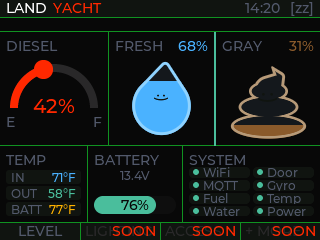
↳ The grey tank is full, by the way.
A monitoring system that answers the questions that actually matter when a parking lot is your neighbourhood — no subscription, no cloud, no yacht prices.
LandYacht is a modular automation system for converted vehicles — vans, Sprinters, skoolies, buses. Built around a Raspberry Pi and a network of cheap wireless sensor nodes, it answers the questions that actually matter when a parking lot is your neighborhood: how much battery do you have, is the water running out, and is this thing level enough that your coffee stays in the cup.
It runs entirely on hardware that costs less than a campsite with a shower. It requires neither a monthly subscription nor the spiritual surrender of connecting another thing to someone else's cloud. It does not care what kind of battery, solar charger, or life philosophy you arrived with.
For the growing army of van and bus dwellers who are nerdy enough to want real data but too broke and too stubborn to pay yacht prices for it.
Eight independent nodes cover every corner of the van. Each publishes to its own MQTT topic. Each is fused, enclosed, and reachable over WiFi for firmware updates. Swap one out — the rest don't notice.
Every sensor node runs on the same board — one spare part covers the whole system.
The same sensor data appears wherever you need it. Each display runs independently — if one goes down, the rest keep running.
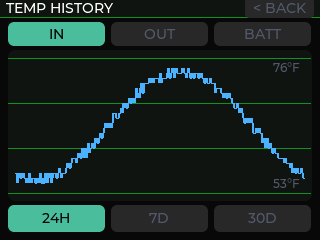
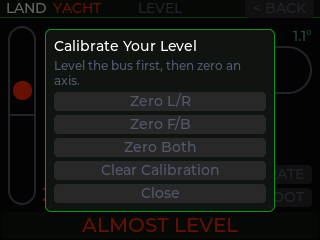
A $10 touchscreen mounted in the dash. Always on. Five subscreens: overview, temperatures, tanks, leveling, door control. Plain-English bubble level. Works with no Pi, no internet, no phone.
Served by the Pi. Live data via WebSocket. Installable as a home screen app — no app store. Accessible from anywhere via encrypted VPN. Same URL, every campsite.
Every sensor, every reading, as far back as the SD card holds. Temperature over two weeks. Water patterns. Battery cycles. Understanding the van as a system over time.
LandYacht doesn't reinvent anything. It assembles proven open-source tools into a van-specific system. Every service runs locally. None of it talks to a cloud unless you tell it to.
These are load-bearing. They define what LandYacht is and what it will never become.
Any node can fail, be replaced, or be skipped without touching anything else. Consolidation feels efficient until it breaks.
Change the hardware, keep the topic. Change the dashboard, keep the topic. The topic structure is the only interface that matters.
Every node is useful on its own. The fuel gauge works without the Pi. The cab display works without the web dashboard.
"VEHICLE LEVEL" not "pitch/roll". "SEALED" not "servo state: 0". The driver is not a developer.
Every component can be sourced independently. Every service can be replaced. The system outlives any single supplier.
The code is free forever under GPL v3. The name LandYacht is trademarked. Both things are true and compatible.
The code is on GitHub. The documentation is plain language. The hardware list is a $20 order. Start with one node, add the rest when you're ready.